
The insurance industry is in a constant state of flux, shaped by technological advancements, evolving consumer expectations, and a dynamic global risk landscape. Staying abreast of these changes is not just beneficial but essential for insurers, brokers, and policyholders alike. Understanding the key Insurance Trends for 2024 offers a competitive edge and ensures readiness for future challenges and opportunities.
This comprehensive guide delves into five essential Insurance Trends that are set to redefine the sector this year and beyond. From the pervasive influence of digital transformation to the increasing focus on sustainability, these trends highlight a period of significant innovation and adaptation. We will explore how these shifts are impacting product development, customer engagement, risk assessment, and operational efficiency, providing valuable insights into what to expect from the evolving world of insurance.
Navigating the Evolving Landscape: Key Insurance Trends
The insurance sector is undergoing a profound transformation, driven by a confluence of technological innovation and a changing risk environment. These forces are not only reshaping how insurance products are designed and delivered but also how companies interact with their customers. Keeping pace with these developments is crucial for anyone involved in the industry.
The Rise of Digital Transformation in Insurance Trends
Digital transformation continues to be a monumental force, fundamentally altering every facet of the insurance value chain. This trend encompasses the adoption of advanced technologies such as Artificial Intelligence (AI), Machine Learning (ML), big data analytics, and automation. These tools are revolutionizing processes from underwriting and claims management to customer service and fraud detection.
In 2024, we are witnessing an accelerated move towards AI-driven underwriting, allowing for more precise risk assessment and personalized policy offerings. Machine learning algorithms can analyze vast datasets, identifying patterns and predicting risks with unprecedented accuracy. This leads to fairer premiums and more tailored coverage options for policyholders.
Automation, particularly through Robotic Process Automation (RPA), is streamlining back-office operations, reducing manual errors, and significantly speeding up processing times. For instance, automated claims processing can resolve straightforward claims in minutes, dramatically improving customer satisfaction. Chatbots and virtual assistants powered by AI are also enhancing customer support, providing instant answers to queries and guiding users through complex processes 24/7. Insurance Trends clearly indicate a shift towards frictionless digital experiences.
Many insurers are investing heavily in data analytics platforms to gain deeper insights into customer behavior and market dynamics. This allows for proactive product development and more targeted marketing strategies. According to a recent industry report, over 70% of insurers plan to increase their investment in AI and data analytics technologies over the next two years, underscoring the critical role digital transformation plays in the future of insurance. This ongoing digital transformation in insurance is one of the most impactful developments.
[Image: Digital transformation in insurance, illustrating the latest insurance trends with AI and data analytics. Alt text: Digital transformation shaping modern insurance trends.]
Emerging Risks and New Insurance Trends
The global landscape is constantly evolving, bringing with it a new array of risks that demand innovative insurance solutions. Climate change, cyber threats, geopolitical instability, and pandemics are no longer theoretical concerns but present tangible and immediate challenges. Insurers are adapting by developing new products and refining their risk assessment models to address these complex perils.
Cybersecurity insurance, for example, has moved from a niche offering to a mainstream necessity. With the increasing frequency and sophistication of cyberattacks, businesses of all sizes are seeking protection against data breaches, ransomware, and business interruption. The market for cyber insurance is projected to grow significantly, reflecting the escalating threat landscape. Understanding these evolving Insurance Trends is vital for businesses.
Climate change poses another monumental challenge, leading to more frequent and severe weather events. This has spurred the development of parametric insurance, where payouts are triggered automatically when predefined environmental conditions are met (e.g., a certain wind speed or rainfall amount), rather than requiring traditional loss assessment. This innovative approach offers quicker relief to affected parties and is a key area within current Insurance Trends.
Furthermore, geopolitical tensions and supply chain disruptions highlight the need for more robust political risk and trade credit insurance. Insurers are working to model these complex, interconnected risks, often leveraging sophisticated predictive analytics and real-time data feeds. Staying ahead of these emerging risks requires continuous innovation and a willingness to embrace new underwriting methodologies. For more insights, refer to various industry reports on risk management.
Customer-Centricity and Personalization: Dominant Insurance Trends
In an increasingly competitive market, customer expectations are higher than ever. Policyholders no longer view insurance as a mere commodity but seek personalized experiences, transparency, and seamless interactions. This shift towards customer-centricity is one of the most defining Insurance Trends today.
Hyper-Personalization and Usage-Based Insurance (UBI)
The era of one-size-fits-all insurance policies is rapidly fading. Today’s consumers expect products and services tailored to their specific needs, behaviors, and risk profiles. Hyper-personalization, enabled by data analytics and IoT devices, is allowing insurers to offer highly customized coverage.
Usage-Based Insurance (UBI) is a prime example of this trend. In auto insurance, telematics devices installed in vehicles or smartphone apps monitor driving behavior, such as speed, braking, and mileage. This data allows insurers to offer premiums that accurately reflect an individual’s actual risk, rewarding safe drivers with lower costs. The UBI market is experiencing rapid growth, with projections indicating it will become a significant segment of the auto insurance industry in the coming years.
Similarly, in health insurance, wearable devices and wellness apps are enabling insurers to offer personalized plans that incentivize healthy lifestyles. Policyholders who meet certain activity goals or maintain healthy habits can receive discounts or rewards. This creates a symbiotic relationship where both the insurer and the insured benefit. These personalized Insurance Trends are fostering a more engaged customer base.
Beyond pricing, personalization extends to policy features, deductibles, and even communication preferences. Insurers are leveraging AI to understand individual customer journeys and offer relevant products at opportune moments, moving away from reactive sales to proactive, value-driven engagement. This level of customization is not just about discounts; it’s about building trust and long-term relationships.
[Image: Personalized insurance policies displayed on a tablet, showing customized options based on individual data. Alt text: Hyper-personalization is a key driver of modern insurance trends.]
Enhancing Customer Experience (CX) with New Insurance Trends
A superior customer experience is no longer a differentiator but a fundamental expectation. Insurers are investing heavily in creating seamless, intuitive, and efficient customer journeys across all touchpoints. This includes everything from initial policy inquiry and purchase to claims filing and ongoing support. The drive for improved CX is a major component of current Insurance Trends.
Digital channels play a crucial role in this enhancement. Online portals, mobile apps, and self-service options empower customers to manage their policies, make payments, and submit claims at their convenience. Real-time updates on claim status via SMS or app notifications provide transparency and reduce anxiety during stressful times. Simplifying policy language and making terms and conditions easier to understand also contributes significantly to a positive experience.
Proactive communication is another key aspect. Insurers are increasingly using data to anticipate customer needs and reach out with relevant information or offers before the customer even has to ask. For example, sending reminders about upcoming renewals or providing tips on risk mitigation. This builds trust and demonstrates a genuine commitment to customer well-being. For more on this, explore topics related to customer experience in insurance.
The focus is on reducing friction at every step, making insurance interactions as simple and transparent as possible. This human-centered design approach, combined with digital efficiency, is setting new benchmarks for service excellence in the industry. These evolving Insurance Trends highlight a shift towards truly putting the customer first.
The Future is Here: Innovative Insurance Trends and Sustainability
Innovation is not just about technology; it’s also about new business models, collaborative ecosystems, and a growing awareness of global responsibilities. The insurance industry is embracing these broader definitions of innovation, driven by both market demands and societal expectations.
Insurtech Innovation and Ecosystem Collaboration
Insurtech, the fusion of insurance and technology, continues to be a powerful engine for innovation. Startups in this space are challenging traditional models, introducing disruptive technologies, and offering novel solutions that often address underserved markets or specific pain points. These innovations are shaping future Insurance Trends.
Areas of significant Insurtech activity include the use of blockchain for enhanced data security and transparent claims processing, peer-to-peer insurance models that foster community and trust, and AI-powered platforms that offer instant quotes and simplified onboarding. Microinsurance, enabled by mobile technology, is also expanding access to insurance in developing regions, providing coverage for specific, small-scale risks.
Critically, the relationship between traditional insurers and Insurtechs is evolving from competition to collaboration. Many incumbent insurers are partnering with startups to leverage their agility and technological prowess, integrating innovative solutions into their existing frameworks. These ecosystem collaborations allow larger companies to innovate faster and offer more sophisticated products, while Insurtechs gain access to capital, customer bases, and regulatory expertise. This symbiotic relationship is accelerating the pace of change within the industry. To learn more, consult recent Fintech/Insurtech reports.
[Image: A diverse team collaborating on an Insurtech project, illustrating innovation and partnership. Alt text: Insurtech innovation is a key component of modern insurance trends.]
Sustainability and ESG Factors Shaping Insurance Trends
Environmental, Social, and Governance (ESG) factors are no longer peripheral concerns but are increasingly central to business strategy across all sectors, including insurance. The industry, as both a risk manager and a significant investor, has a unique role to play in promoting sustainability. This focus on ESG is one of the most impactful long-term Insurance Trends.
From an underwriting perspective, insurers are integrating climate risk assessments into their models, evaluating the environmental impact of industries they insure, and developing “green” insurance products. These might include policies for renewable energy projects, electric vehicles, or businesses committed to sustainable practices. They are also withdrawing coverage from high-carbon industries, reflecting a broader commitment to climate action.
On the investment side, insurers, with their vast asset portfolios, are increasingly directing capital towards companies with strong ESG credentials and away from those with poor environmental or social records. This “responsible investment” approach seeks to generate both financial returns and positive societal impact. The pressure from regulators, investors, and consumers for greater corporate responsibility is driving these changes.
Social factors, such as diversity, equity, and inclusion within the workforce, and fair treatment of customers, are also gaining prominence. Governance aspects, including ethical leadership and transparent reporting, ensure that sustainability commitments are genuinely embedded within an organization’s culture and operations. As one of the critical Insurance Trends, ESG considerations are reshaping the industry’s moral and financial compass.
Conclusion
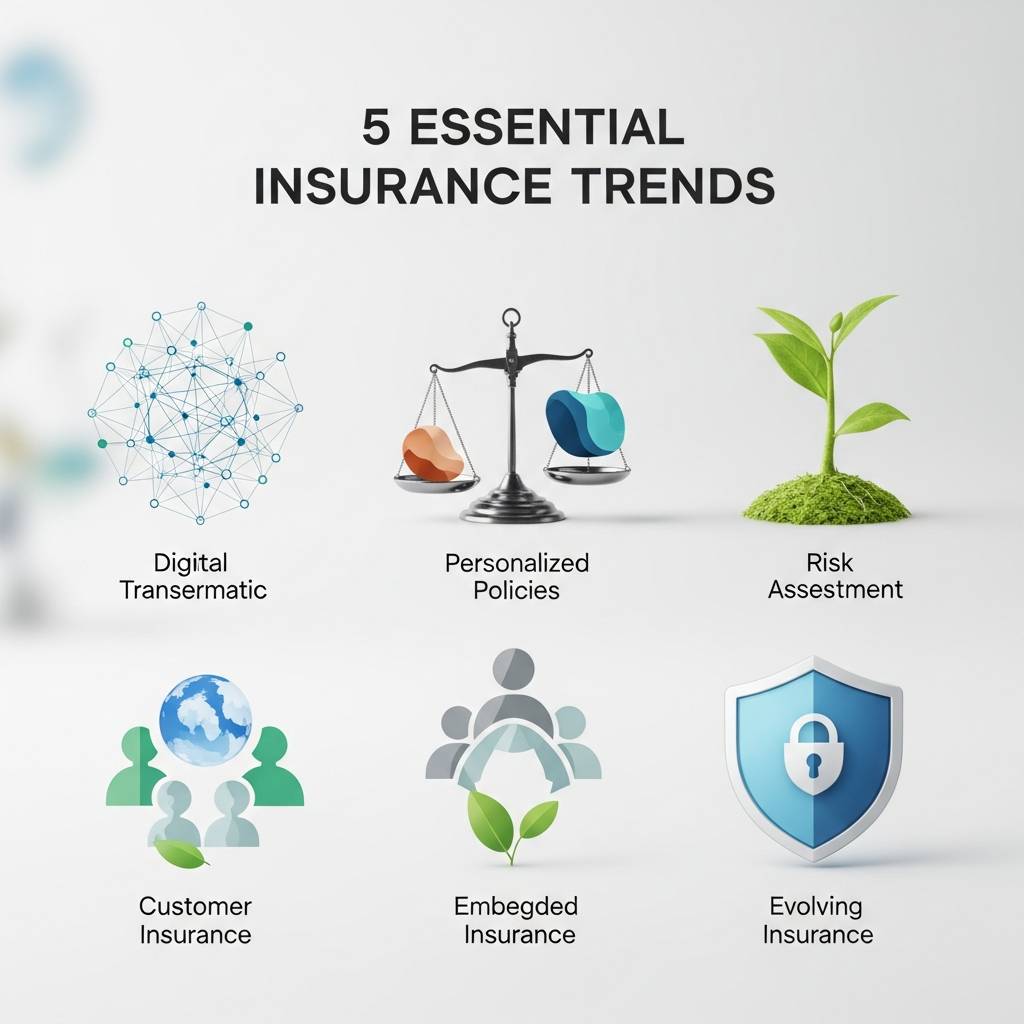
The insurance industry is navigating a period of unprecedented change, driven by technological advancements, evolving customer expectations, emerging risks, and a growing emphasis on sustainability. The five essential Insurance Trends discussed – digital transformation, emerging risks, hyper-personalization, enhanced customer experience, Insurtech innovation, and ESG integration – are not isolated phenomena but interconnected forces reshaping the sector’s future.
For insurers, adapting to these Insurance Trends means embracing agility, investing in cutting-edge technology, fostering a customer-centric culture, and demonstrating a commitment to responsible business practices. For policyholders, these trends promise more tailored, transparent, and efficient insurance solutions that better meet their evolving needs in a complex world.
Staying informed and proactive is key to thriving in this dynamic environment. As these Insurance Trends continue to unfold, the industry will undoubtedly become more resilient, innovative, and ultimately, more valuable to society. Don’t be left behind in this transformative era. Explore how these Insurance Trends can benefit you or your business today. Contact us to learn more about tailored insurance solutions that align with the future of the industry.